
Hair Restoration in Albania
Understand What's Possible Before You Plan the Procedure.
Hair restoration can involve more decisions than simply choosing a clinic or comparing a graft count. American-Guided helps you organize what you already know, understand potential provider options, and identify the questions worth asking before making a commitment.
A good starting point isn't a procedure name. It's understanding your individual situation.
More Than a Graft Count
Hair Restoration Starts With Understanding What You're Working With.
Two people seeking hair restoration may have very different patterns of hair loss, donor-area characteristics, goals, medical considerations, and long-term needs. That is why meaningful planning requires more than selecting a package based on a number of grafts.
- Pattern and extent of hair loss
- Donor-area characteristics
- Age and potential future hair loss
- Hair characteristics
- Previous hair-restoration procedures
- Medical history where relevant
- Desired hairline and coverage goals
- Estimated graft requirements
- Procedure approach
- Provider experience
- Recovery expectations
- Long-term planning
The goal isn't simply to move hair. It's to understand the plan — including what may happen years from now.
Medical causes of hair loss and treatment candidacy must be evaluated by appropriately qualified healthcare professionals.
Technique Matters — But So Does Context
FUE, FUT, DHI — What Do These Terms Actually Tell You?
Hair-restoration terminology can make comparison difficult. Technique names may describe only part of the process, and terminology may be used differently between providers. Understanding exactly what a provider means is more useful than choosing based on an acronym alone.
FUE
Follicular unit extraction generally refers to harvesting follicular units individually from the donor area. Specific equipment and approaches can vary between providers.
FUT
Follicular unit transplantation generally involves removing a strip of donor tissue from which follicular units are prepared for transplantation. Suitability depends on individual circumstances and provider evaluation.
DHI
“DHI” is commonly used in hair-restoration marketing to describe implantation using particular implanter methods or devices. Patients should ask the provider exactly what technique and steps are being proposed rather than assuming the label alone determines quality or suitability.
The acronym is not the treatment plan.
Ask what will actually be done, why that approach is being proposed for you, who performs each step, and what alternatives may be appropriate.
A Finite Resource
Your Donor Area Matters.
Hair used for transplantation generally comes from a limited donor area. That makes donor management an important part of both the immediate procedure and longer-term planning.
- Donor density and characteristics
- Estimated number of grafts proposed
- How graft estimates are determined
- Extraction pattern
- Avoiding unnecessary donor depletion
- Previous procedures and existing donor use
- Potential future needs
- Whether additional sessions might ever be considered
More grafts is not automatically a better plan.
A qualified professional should evaluate what may be appropriate for the individual patient rather than treating graft count as a universal measure of quality.
Know Who Is Doing What
A Clinic Name Doesn't Tell You Who Will Perform Each Step.
Hair restoration may involve several distinct stages, and responsibilities can vary between providers and jurisdictions. Before committing, understand who is responsible for evaluating you, designing the plan, performing the procedure, and providing follow-up care.
Evaluation & Planning
Who evaluates candidacy and develops the proposed treatment plan?
Hairline Design
Who determines and discusses the proposed hairline and distribution strategy?
Donor Extraction
Who performs the extraction or harvesting step?
Recipient-Site Creation
Where applicable, who creates the recipient sites and determines placement?
Implantation
Who performs or participates in implantation?
Post-Procedure Care
Who is responsible for postoperative instructions and clinical follow-up?
Don't stop at "Who is the doctor?" Ask who will actually perform each part of your procedure.
Scope-of-practice requirements vary. Patients should obtain clear information directly from the provider about who performs each stage of care.
Planning Beyond Today
A Hairline Should Be Considered in the Context of the Future, Too.
Hair restoration planning may need to consider not only existing hair loss but how surrounding native hair could change over time. A proposed hairline, graft distribution, density strategy, and donor usage should be discussed in the context of realistic expectations and longer-term planning.
Questions About the Design
- Why is this hairline being proposed?
- How was the graft estimate determined?
- How will grafts be distributed?
- What density is realistically anticipated?
- How are existing native hairs being considered?
Questions About the Future
- Could my hair loss continue?
- How might future loss affect the appearance?
- Is donor capacity being preserved?
- Could another procedure ever be considered?
- What long-term follow-up may be appropriate?
The plan should make sense beyond the day of the procedure.
Patience Is Part of the Process
Hair Restoration Isn't an Overnight Result.
Transplanted hair and the surrounding scalp go through a recovery and growth process that unfolds over time. Early appearance should not be confused with a final result.
Procedure & Early Recovery
Initial postoperative healing and provider-directed care.
Early Months
Appearance can change considerably as the normal post-procedure process unfolds.
Continued Growth
Visible changes may develop gradually over subsequent months.
Longer-Term Evaluation
Providers generally evaluate the result over an extended period rather than immediately after the procedure.
Individual timelines vary. Your treating professional should explain what may reasonably be expected in your individual case.
Look Beyond the Transformation
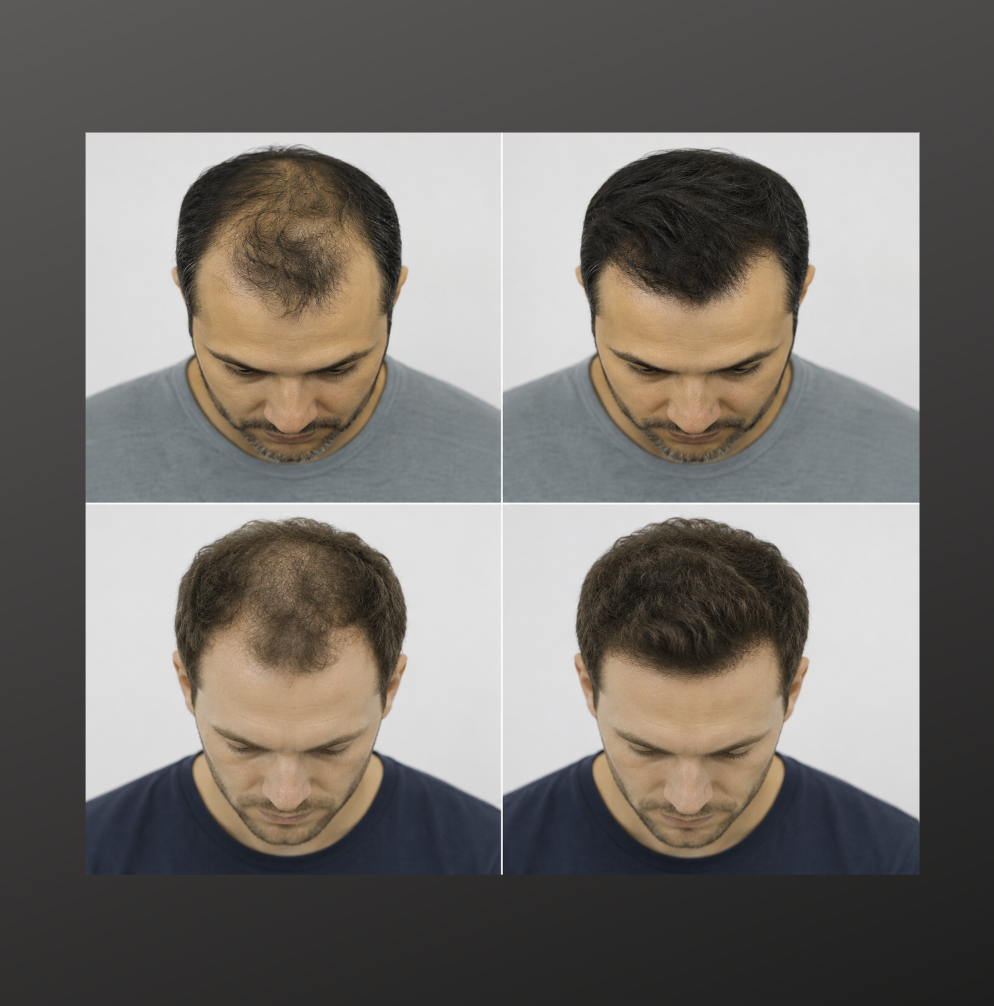
Before-and-After Photos Can Start a Conversation. They Shouldn't End It.
Photos can help demonstrate a provider's work, but they do not tell you everything about how a case was selected, photographed, treated, or followed.
When reviewing results, ask:
- Is this the same patient in both images?
- Are lighting, angle, hairstyle, and hair length reasonably comparable?
- How long after the procedure was the final image taken?
- How many procedures were performed?
- Approximately how many grafts were used?
- Was any additional treatment involved?
- Is this case reasonably comparable to mine?
- Who performed the procedure shown?
A dramatic photograph is not a substitute for understanding your own candidacy and plan.
The Procedure and the Trip Have to Work Together
Plan the Stay Around the Care — Not the Other Way Around.
Once a provider has clarified the anticipated procedure and follow-up schedule, practical travel planning becomes much easier.
Length of Stay
Understand how long the treating provider expects you to remain locally for appropriate follow-up.
Post-Procedure Appointments
Clarify what checks or appointments are anticipated before departure.
Accommodations
Consider location, convenience, comfort, and access to appointments.
Local Transportation
Plan transportation between accommodations, appointments, the airport, and other destinations.
Post-Procedure Appearance
Ask what visible signs of the procedure may be expected during the initial recovery period so you can plan accordingly.
Flying Home
Follow the treating professional's guidance regarding appropriate travel timing.
Follow-Up From the United States
Understand how questions and follow-up communication will work once you return home.
Planning Your Stay
Albania is part of the treatment plan, too.
Once your anticipated procedure and follow-up schedule are clearer, we can help you understand the practical side of your stay — location, transportation, accommodations, and navigating Albania around your appointments.
Explore DestinationsMedical and postoperative instructions must come from the licensed treating professional. American-Guided provides practical guidance and care-navigation support.
Better Questions
Before You Commit, Understand the Details.
Hair loss has many possible causes, and some may warrant medical evaluation before any procedure is considered. Determining the cause and whether transplantation is appropriate is the responsibility of a qualified healthcare professional — not American-Guided.
Candidacy depends on factors such as the pattern and stability of hair loss, donor-area characteristics, overall health, and realistic expectations. Only a qualified treating professional can determine whether you are an appropriate candidate.
Understanding what a provider actually means by a technique name — and why they consider it appropriate for your case — is more useful than choosing based on an acronym. Ask what will be done, what alternatives exist, and how the decision was reached.
Hair restoration may involve several distinct stages — evaluation, hairline design, extraction, recipient-site creation, and implantation. Responsibilities can vary between providers and jurisdictions. Confirm who is responsible for each step before committing.
Hairline design has a significant impact on the appearance and long-term suitability of a result. Understanding who designs it, how the proposal was reached, and how it accounts for future hair loss is worth clarifying directly with the provider.
Graft estimates should reflect your individual pattern of loss, goals, and donor characteristics rather than a generic package. Ask how the number was determined and whether it accounts for realistic coverage and donor preservation.
Donor hair is a finite resource. Understanding your donor density, quality, and how the provider plans to manage it — both now and potentially in the future — helps you evaluate whether the proposal is thoughtful.
Hair loss can be progressive. A plan that looks good today may not account for changes over time. Ask how the provider is considering future loss, donor preservation, and whether another procedure might ever be needed.
Depending on the progression of hair loss and the goals of treatment, additional sessions may be a consideration for some patients. This depends on individual circumstances and should be discussed with the treating professional.
Realistic expectations depend on your individual characteristics, the extent of loss, donor availability, and the proposed approach. The treating professional — not American-Guided — is responsible for helping you understand what may be realistically achievable.
Early recovery can involve visible signs of the procedure and a normal shedding phase. Understanding what to expect helps you plan your time in Albania and your return home. Your treating provider should give you specific postoperative instructions.
Transplanted hair and the surrounding scalp go through a gradual recovery and growth process. Providers generally evaluate results over an extended period. Individual timelines vary, and your treating professional should explain what may reasonably be expected in your case.
Length of stay depends on the procedure and the follow-up the treating provider considers appropriate. This should be clarified before you book travel so you can plan accordingly.
Understanding what checks or appointments are anticipated before departure helps you plan timing and anticipate the full scope of care while you are in Albania.
Understanding how questions and follow-up communication will work once you are home helps you plan for the full journey, not just the time in Albania.
Before proceeding, it helps to understand how the provider communicates about aftercare, how concerns are handled remotely, and what practical options exist if a question arises after you return.
Medications or adjunctive therapies may be discussed as part of a broader plan. Whether any medication is appropriate for you is a clinical decision that must be made by a qualified healthcare professional, not American-Guided.
Independent Patient Guidance
We Help You Navigate the Process — We Don't Practice Medicine.
What We Help With
- Organizing available information
- Understanding preliminary proposals
- Comparing what different proposals actually include
- Identifying questions worth asking
- Understanding provider information
- Facilitating communication
- Understanding practical next steps
- Preparing for Albania
- Local American-guided support
- Navigating practical considerations
- Understanding follow-up expectations
What We Don't Do
- Diagnose the cause of hair loss
- Determine candidacy
- Determine treatment
- Select a technique on a patient's behalf
- Prescribe medication
- Perform procedures
- Guarantee graft survival
- Guarantee hair growth
- Guarantee density
- Guarantee outcomes
- Guarantee provider availability
- Guarantee savings
- Replace the treating healthcare professional
- Provide emergency medical care
Licensed healthcare professionals remain solely responsible for examination, diagnosis, candidacy assessment, informed consent, treatment recommendations, procedures, prescriptions, postoperative instructions, and clinical care.
You Don't Need to Know the Technique
Start With What You Want to Understand.
Tell Us What You're Considering
Share your goals, concerns, previous recommendations, or simply what you hope to better understand.
Share What You Already Have
If available, share photographs, previous consultations, treatment estimates, medical information supplied by your providers, or questions.
Understand the Next Step
American-Guided helps organize the information and determine the appropriate next step for exploring provider possibilities.
Confidence Before Commitment
Understand the Plan Before You Choose the Procedure.
Whether you already have a proposal in hand or you're only beginning to explore hair restoration in Albania, you can start with what you know today.
No pressure. No clinic commitment. Confidence before commitment.